What our food lost, and what your cycle needs
Test, don't guess. A blood test costs less than a month of pills you might not need.
Something I've been reading into, and it turned into more than a note: the vegetables and fruit we buy today carry less of some minerals and vitamins than the same crops 50 to 80 years ago — the studies put it between roughly 6 and 38 percent depending on the nutrient. That matters more for women than for most people, because iron, magnesium, B6 and vitamin D all move with the cycle. So here is the long version: what the studies actually show, where women stand today, what a period costs in iron, and what to do about it. Every number has a source at the bottom.
A note on how this came about: a friend pointed me to the nutrition score printed on many German products, A to E. We stood in the shop and most of what we picked up was a D or an E. The first A we found was a mix of nuts and seeds that looked like bird food. Since then I read that little label, and I read the studies below. Otherwise we just get full, fat and tired, when we could eat less and feel energised because the body got what it needs.
what changed in our food
the most cited study compared US nutrition tables for 43 garden crops, 1950 versus 19991. six of thirteen nutrients showed a reliable drop in the median: protein −6 %, phosphorus −9 %, iron −15 %, vitamin C −15 %, calcium −16 %, riboflavin (B2) −38 %. the other seven did not change reliably. a UK comparison of 1940 versus 2019 found iron −50 %, copper −49 % and magnesium −10 % across 20 vegetables and 20 fruits2,3.
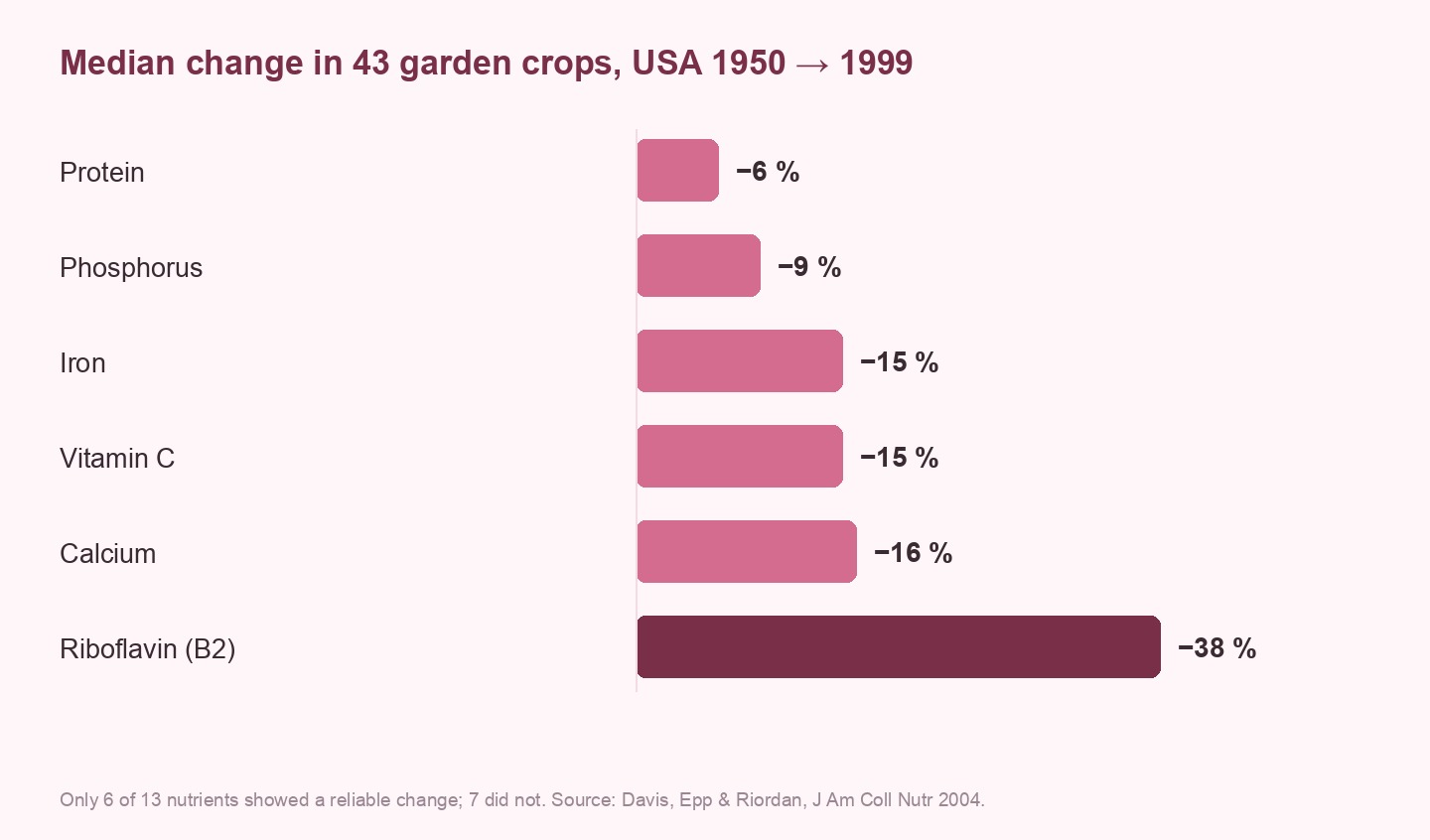
only 6 of 13 nutrients showed a reliable change; 7 did not. source: Davis, Epp & Riordan, J Am Coll Nutr 2004.
the honest caveat. a 2017 review4 warns that comparing tables decades apart is shaky: varieties, origin, ripeness and lab methods all changed. the "30 % less" headline you may have seen is a simplification. what holds up: some nutrients in some crops are lower, most plausibly because of high-yield varieties (the "dilution effect"), and this is best documented in wheat. the variety you buy and how fresh it is matter more than the decade.
where women actually stand
the food tables are the small story. the big one is what is measured in women's blood and diets today5–10:
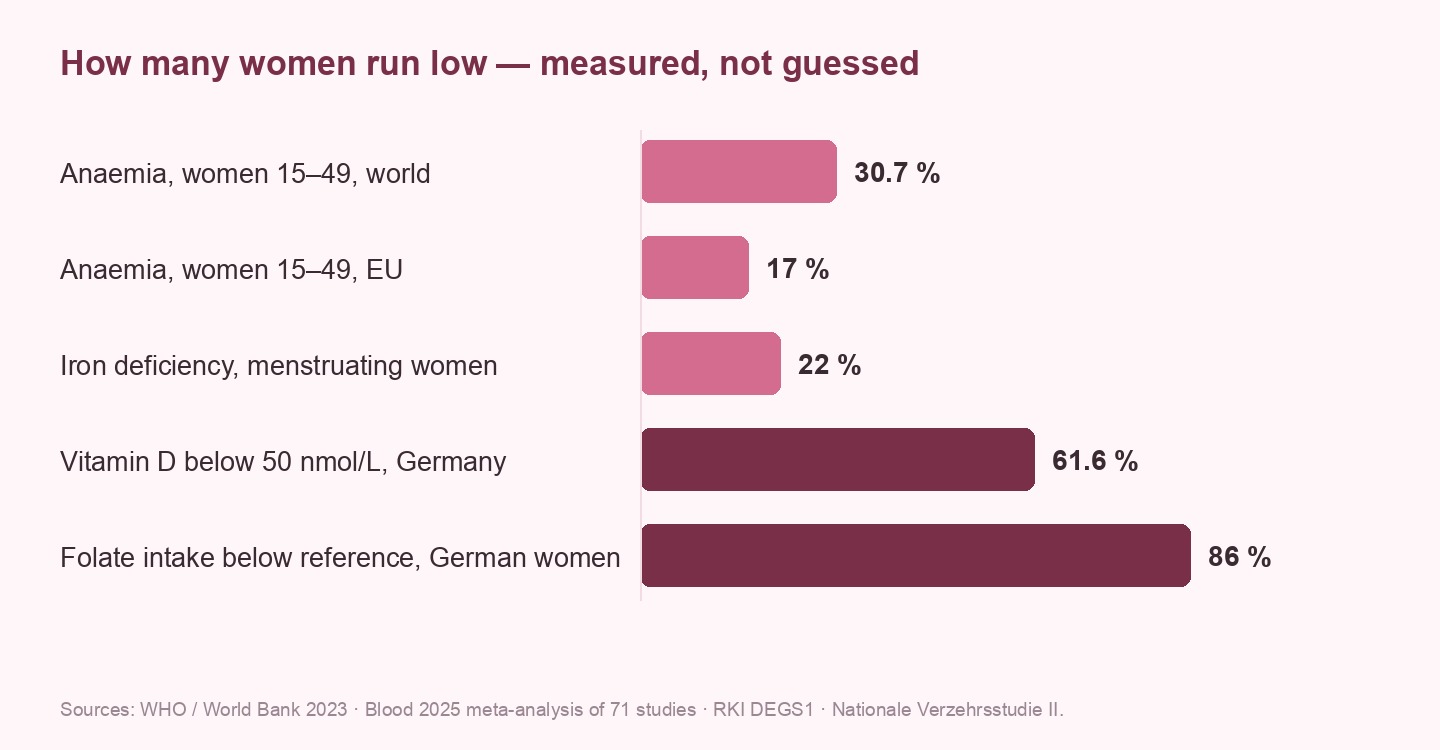
sources: WHO / World Bank 2023 · Blood 2025 meta-analysis of 71 studies (270,907 women) · RKI DEGS1 (6,995 adults) · Nationale Verzehrsstudie II.
- anaemia: 30.7 % of women aged 15–49 worldwide, 17 % in the EU, 13.9 % in germany. the global number has barely moved since 20005,6.
- iron deficiency (low ferritin) in menstruating women: 22 % across 71 studies, 27 % when inflammation is accounted for7. in germany, more than 75 % of women under 50 do not reach the recommended iron intake9.
- vitamin D: 61.6 % of german adults are below 50 nmol/L, 30.2 % below 30 nmol/L, mostly in winter10.
- folate: 86 % of german women eat less than the reference9. magnesium: 29 %9. iodine: germany still counts as a mild-deficiency area13.
- B12: fine for most; a real risk if you eat vegan and don't supplement11,12.
what this has to do with your cycle
every period costs iron. about 0.4–0.5 mg per millilitre of blood; the median bleed is 20–30 ml, so roughly 10–15 mg per cycle14–16. with heavy periods (over 80 ml, fewer than 1 in 10 women) it is 32–40 mg. that is why heavy bleeding is a named risk group for iron deficiency, and why a ferritin test is the first thing gynaecologists recommend when bleeding is heavy14,15.
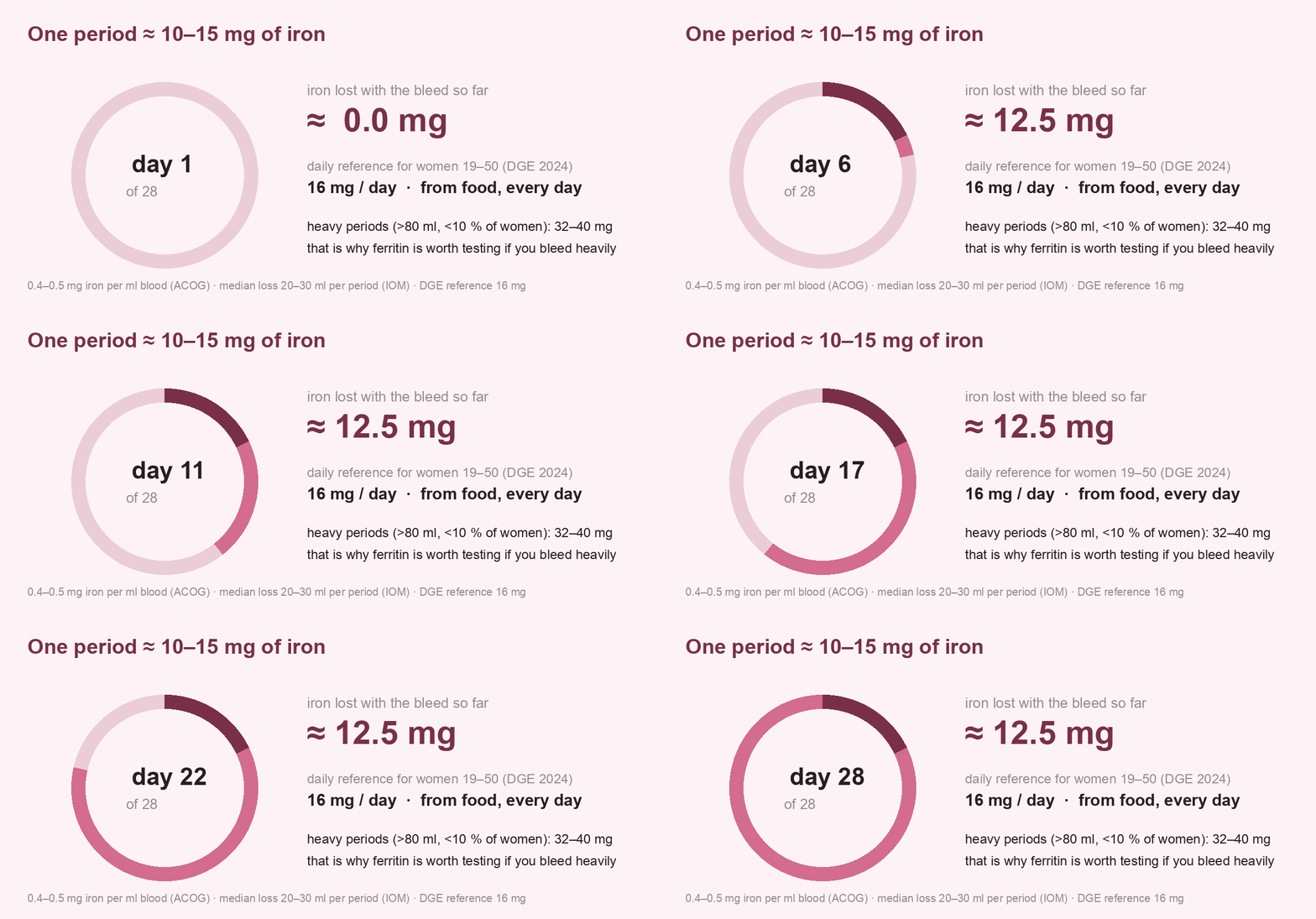
reference intake for women 19–50: 16 mg iron per day from food (DGE 2024). the body absorbs only a fraction, which is why the daily number is higher than the monthly loss.
and the supplements everyone talks about for PMS and cramps? here is what the trials actually show, sorted by how solid the evidence is:
| nutrient | what was found | evidence |
|---|---|---|
| iron | measured deficiency is common and the fix is well established: eat iron-rich food, test ferritin if periods are heavy or you are often tired7,14,15 | strong |
| calcium | 1,200 mg/day for 3 cycles cut PMS symptom scores by 48 % vs 30 % on placebo in 466 women. one large trial, 199822 | moderate |
| vitamin B6 | 9 trials, 940 women: about twice the odds of PMS improvement. but the trials were of mixed quality, and the EU safety limit is now 12 mg/day because of nerve damage at high doses20,21 | moderate, dose caution |
| omega-3 | 8 small studies: clearly less period pain at 300–1,800 mg/day over 2–3 months. promising, not proven26,27 | moderate |
| magnesium | "promising" for cramps in 2001, "no high-quality evidence" in the 2016 update; for PMS "insufficient evidence" in 202417–19 | weak / mixed |
| vitamin D | less period pain in two meta-analyses, but mostly high-dose trials that disagree with each other; PMS: inconclusive23–25 | weak / mixed |
| "detox" | no trial base at all. megadoses have documented harm: B6 above 12 mg, iron above 40 mg, supplemental magnesium above 250 mg21,28,29 | none |
what to actually do
food first. these are the german reference values for women 19–50 and where the nutrients sit30–35:
| nutrient | per day | best from |
|---|---|---|
| iron | 16 mg (11 mg if you don't menstruate) | lentils, beans, oats, pumpkin seeds, red meat. add vitamin C (peppers, citrus), keep coffee and tea an hour away |
| magnesium | 300 mg | whole grains, nuts, seeds, legumes, dark greens |
| vitamin D | 20 µg when there is no sun | oily fish, eggs; sun on skin april–september |
| folate | 300 µg (+400 µg folic acid if pregnancy is possible) | greens, legumes, whole grain |
| iodine | 150 µg | iodised salt, sea fish, dairy |
| B12 | 4 µg | animal foods; vegans: supplement, no way around it |
test, don't guess. ferritin (plus CRP) if your periods are heavy, tiredness won't go, or you eat mostly plants. 25(OH)-vitamin D in winter. B12 if you are vegan. then supplement only the measured gap, within the safety limits, with your doctor. a blood test costs less than a month of pills you might not need.
- Davis DR, Epp MD, Riordan HD. Changes in USDA food composition data for 43 garden crops, 1950 to 1999. J Am Coll Nutr 2004;23:669–82. pubmed
- Mayer AM. Historical changes in the mineral content of fruits and vegetables. Br Food J 1997;99:207–11.
- Mayer AM, Trenchard L, Rayns F. Historical changes in the mineral content of fruit and vegetables in the UK from 1940 to 2019. Int J Food Sci Nutr 2022;73:315–26. link
- Marles RJ. Mineral nutrient composition of vegetables, fruits and grains: the context of reports of apparent historical declines. J Food Compos Anal 2017;56:93–103. link
- Stevens GA et al. National, regional, and global estimates of anaemia by severity in women and children, 2000–19. Lancet Glob Health 2022. link
- WHO estimates via World Bank, indicator SH.ANM.NPRG.ZS, 2023. link
- Global prevalence of iron deficiency in menstruating women, meta-analysis of 71 studies. Blood 2025. link
- Swiss cross-sectional study on iron status in young women. link
- Nationale Verzehrsstudie II, Ergebnisbericht Teil 2, Max Rubner-Institut 2008, pp. 133–170. pdf
- Rabenberg M et al. Vitamin D status among adults in Germany (DEGS1). BMC Public Health 2015. link
- Pawlak R et al. Prevalence of cobalamin deficiency among vegetarians. Eur J Clin Nutr 2014. link
- Micronutrient status of omnivores, vegetarians and vegans in Germany. Ann Med 2023. link
- BMLEH / RKI, Jodversorgung in Deutschland (DEGS). link
- ACOG Committee Opinion 785, Screening and management of bleeding disorders in adolescents with heavy menstrual bleeding, 2019. link
- NIH Office of Dietary Supplements, Iron fact sheet for health professionals. link
- Institute of Medicine, Dietary Reference Intakes: Iron (menstrual blood-loss medians). link
- Proctor ML, Murphy PA. Herbal and dietary therapies for primary and secondary dysmenorrhoea. Cochrane 2001. link
- Pattanittum P et al. Dietary supplements for dysmenorrhoea. Cochrane 2016. link
- Magnesium and premenstrual syndrome, systematic review of RCTs. Nutrition Reviews 2025;83:280. link
- Wyatt KM et al. Efficacy of vitamin B6 in the treatment of premenstrual syndrome: systematic review. BMJ 1999. link
- EFSA, Scientific opinion on the tolerable upper intake level for vitamin B6, 2023. link
- Thys-Jacobs S et al. Calcium carbonate and the premenstrual syndrome. Am J Obstet Gynecol 1998. link
- Vitamin D supplementation for primary dysmenorrhoea, meta-analysis 2023. link
- Vitamin D and dysmenorrhoea, meta-analysis with trial sequential analysis 2024. link
- Arab A et al. Vitamin D and premenstrual syndrome. J Am Coll Nutr 2019. link
- Snipe RMJ et al. Omega-3 and dysmenorrhoea, systematic review. Nutr Diet 2024. link
- Omega-3 fatty acids for primary dysmenorrhoea, meta-analysis. Eur J Clin Pharmacol 2022. link
- EFSA, Safe level of intake for iron, 2024. link
- BfR, Maximum daily level for magnesium in food supplements. link
- DGE, Referenzwerte Eisen (2024). link
- DGE, Referenzwerte Magnesium. link
- DGE, Referenzwerte Vitamin D. link
- DGE, Referenzwerte Folat. link
- DGE, Referenzwerte Jod (2025). link
- DGE, Referenzwerte Vitamin B12. link
this is general information, not medical advice. if something feels off, talk to your doctor.
Want to tell me what you think? Close this and tap 💬 Message Christian in the app — it comes straight to me.
 From Christian · MyDays X · one person, since 2008